Washing Machine Not Draining? 8 Common Causes and How to Fix It

A washing machine not draining usually means water is being blocked somewhere between the drum and the household drain. The most common causes are a clogged filter, kinked drain hose, incorrect hose setup or a problem with the drain pump.
Start with the simple checks first. In many cases, you can identify the cause without taking the machine apart. If water is still sitting inside the drum, drain it carefully before opening the filter or moving the washer.
Quick Diagnosis
| What you notice | Check first |
|---|---|
| Water is still inside the drum | Drain filter and drain hose |
| Washing machine is draining slowly | Partial blockage in the filter, hose or waste pipe |
| Pump hums but little or no water leaves | Filter, hose or pump area |
| Machine stops before the final spin | Check whether the water has drained |
| Clothes are still soaking wet | Drainage first, then load and spin setting |
| Problem started after moving the washer | Kinked or badly positioned drain hose |
| Filter and hose are clear but water remains | Drain pump or another internal fault |
Start with the checks that do not require dismantling the machine. A trapped coin, clogged filter or crushed hose can produce symptoms that look much more serious than they really are.
Before You Start
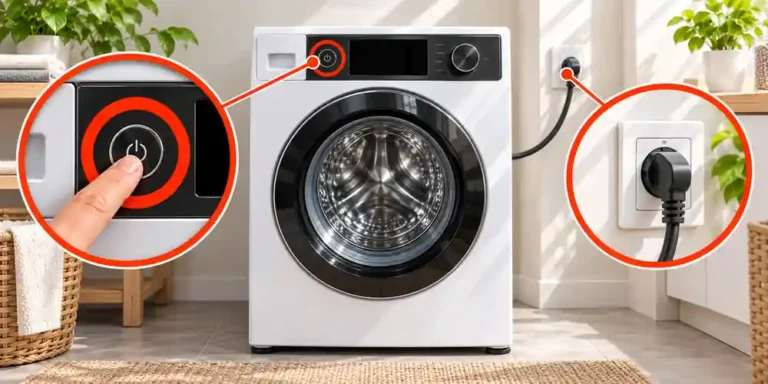
Switch the washing machine off and unplug it before opening the filter area, moving the appliance or disconnecting an accessible drain hose.
If the machine has recently completed a hot wash, allow the water to cool before attempting to drain it.
Keep several towels and a shallow tray nearby. A washer that has failed to empty can contain much more water than expected.
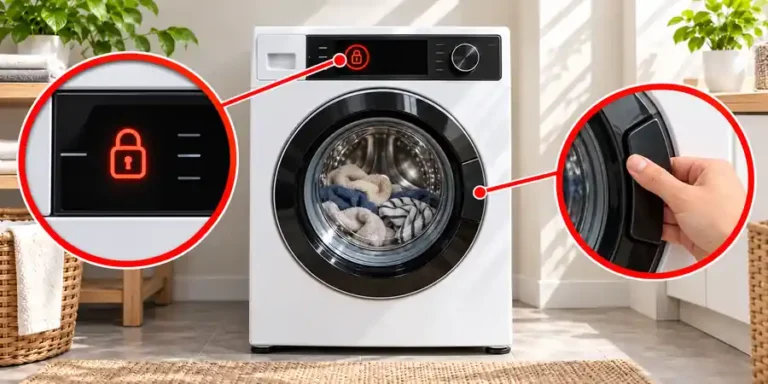
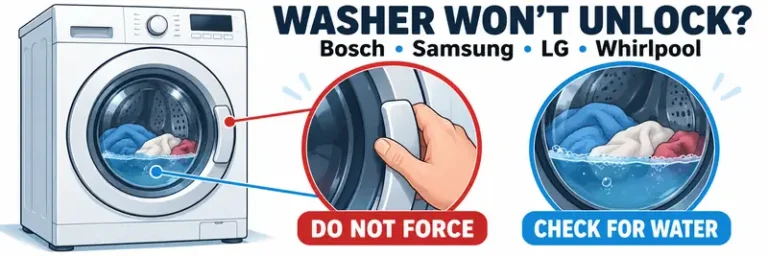
Do not force open a locked front-loading door while water is still visible inside the drum.
The position of the filter, emergency drain hose and other drainage components varies between manufacturers and models. If something on your machine looks different, check the instructions for your exact model before removing it.
1. The Drain Filter Is Blocked
A blocked drain filter is one of the first things worth checking when a washing machine will not drain.
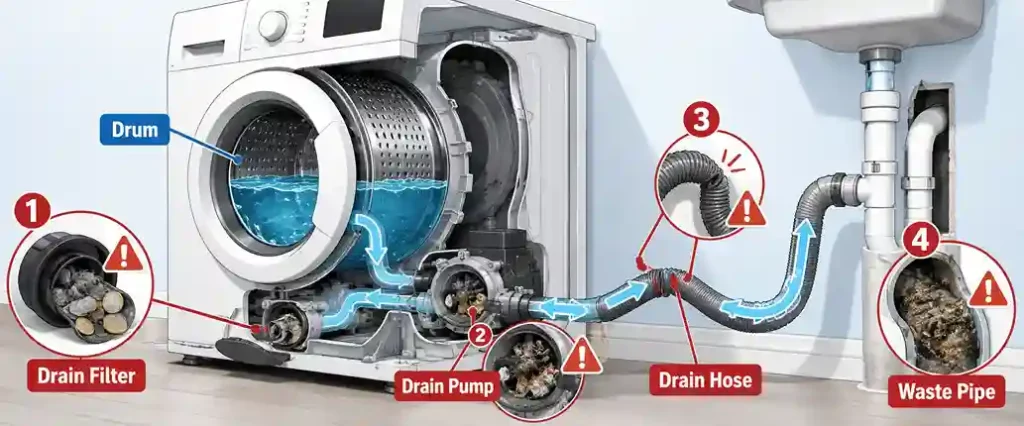
On many front-loading machines, the filter sits behind a small access panel near the bottom of the appliance. It protects the drain pump by catching lint and small objects before they can travel farther through the drainage system.
Coins, hair clips, buttons, threads and pieces of fabric can accumulate around the filter.
Over time, that debris can reduce the amount of water passing through.
Samsung explains that a clogged drain-pump filter can prevent proper drainage, leave clothes wet and make a cycle take longer than expected. Samsung UK drain-filter guidance
Signs of a Blocked Drain Filter
You may notice:
- water remaining inside the drum;
- drainage becoming slower than normal;
- a humming sound while the washer attempts to empty;
- clothes remaining much wetter than usual;
- the programme taking longer to finish;
- the machine failing to reach its normal final spin.
How to Check the Drain Filter
Switch the appliance off and unplug it.
Find the filter access panel. On many front-loading machines it is close to floor level at the front.
If there is a small emergency drain hose beside the filter, use that to remove the trapped water first.
Place towels around the area and position a shallow tray underneath.
Loosen the filter slowly.
If water begins escaping, allow it to drain in controlled amounts rather than immediately pulling the filter out.
Once the water stops, remove the filter.
Clear away any lint, coins, hair or other debris.
Rinse the filter and look inside the accessible filter housing for anything else that could restrict water flow.
Refit the filter securely before testing the machine.
If the filter is clean and the washer still holds water, move to the drain hose.
2. The Drain Hose Is Kinked or Blocked
The drain hose carries used water from the washer to the household waste system.
If it becomes crushed, twisted or partially blocked, the pump may struggle to move water through it.
This is especially worth checking if the machine was recently:
- installed;
- moved;
- pulled forward for cleaning;
- pushed closer to the wall;
- reconnected after plumbing work.
Check Behind the Washer
Look along as much of the visible hose as you can.
Make sure it is not trapped between the appliance and wall.
Check for sharp bends, crushing or twisting.
A hose does not have to be completely blocked to cause trouble.
A partial restriction can leave a washing machine draining slowly while still allowing some water to escape.
If you can safely reach the outlet end of the hose, check the connection for obvious debris.
Samsung also recommends checking the full drain hose for kinks, crushing and blockages when a machine cannot drain correctly. Samsung UK washing-machine drainage checks
If the hose is clear, check its installation next.
3. The Drain Hose Is Installed Incorrectly
A drain hose can be completely clear and still cause drainage problems if it has been fitted incorrectly.
The hose height, the way it enters the standpipe and how far it is inserted can affect drainage.
A hose pushed too deeply into the waste pipe can contribute to siphoning or poor drainage on some installations.
The correct setup varies between machines, so there is no single measurement that should be applied to every brand and model.
Think About When the Problem Started
If the washing machine drained normally before it was moved or installed somewhere else, and the problem appeared immediately afterwards, the drain-hose position deserves close attention.
Check that the hose:
- is not crushed;
- is not sharply bent;
- follows the intended route;
- enters the waste connection correctly;
- is positioned at the height required for your machine.
The installation instructions supplied with the appliance should give the correct measurements for your model.
4. The Sink Waste or Standpipe Is Blocked
Sometimes the washing machine itself is capable of pumping water out, but the household drain cannot carry that water away.
If the washer connects beneath a kitchen or utility-room sink, grease, detergent residue and debris can gradually restrict the waste connection.
A standpipe can also become partially blocked.
Look Beyond the Washing Machine
Check whether the nearby sink drains normally.
A slowly draining sink is an important clue.
Other signs can include:
- water backing up into the sink;
- unusual gurgling;
- water rising in the standpipe;
- drainage problems beginning after plumbing work.
Where a washing-machine drain hose connects beneath a sink, the connection itself can also become obstructed.
If both the sink and washer are struggling to drain, the household waste system becomes more likely than a failed washing-machine pump.
Replacing parts inside the appliance will not solve a blockage farther down the drain.
5. The Selected Programme Is Holding Water
Before assuming that a component has failed, check the programme selected on the control panel.
Some washing machines have settings such as:
- Rinse Hold;
- No Spin;
- reduced spin;
- delicate programmes;
- hand-wash programmes.
Depending on the model, a programme may intentionally pause or behave differently before the final drainage and spin stages.
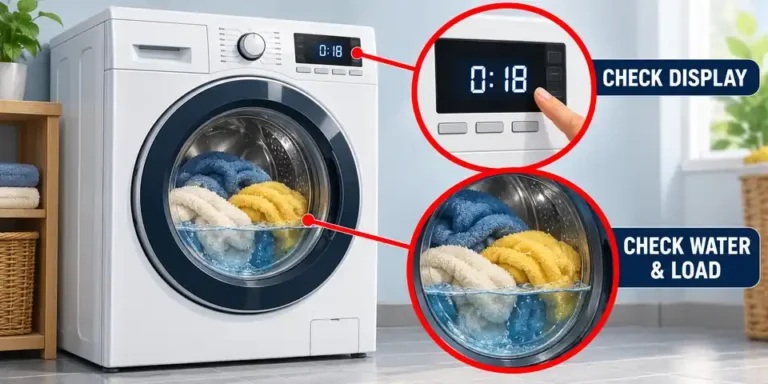
Check the display and programme selector.
If your machine offers a dedicated Drain or Drain & Spin option, try that.
If the washer empties normally when a drain programme is selected, the drainage system may be functioning correctly and the original programme or setting may explain the behaviour.
Do not keep repeatedly running full wash cycles just to test drainage. A dedicated drain programme is faster and puts less unnecessary load on the appliance.
6. The Internal Drainage Path Is Restricted
The external filter and drain hose are not the only places where debris can collect.
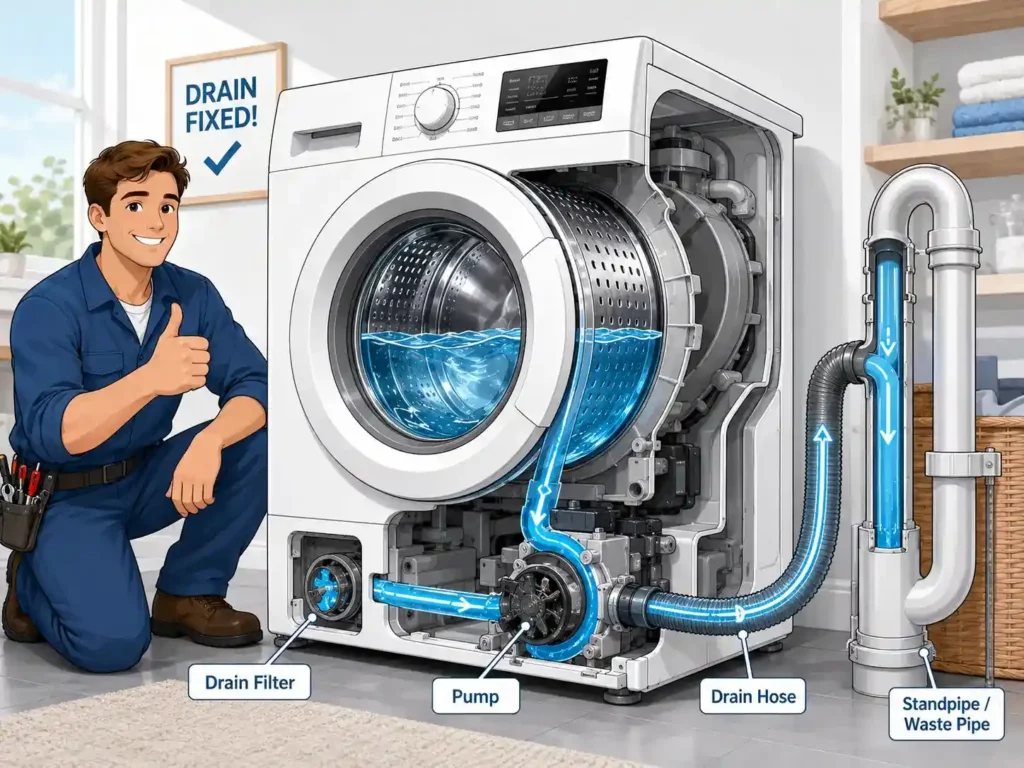
Water usually has to travel from the drum through internal hoses, the filter or pump chamber, the drain pump and finally the external drain hose.
A small item can occasionally move farther into this path than the accessible filter.
Possible obstructions include:
- small socks;
- pieces of fabric;
- coins;
- hair accessories;
- lint;
- fragments from damaged clothing.
A Useful Clue
If the visible filter and external hose are clear but the machine still drains very slowly, an internal restriction becomes more plausible.
You may also hear the pump working for much longer than usual.
Access to internal hoses differs greatly between models and can involve removing appliance panels.
If the blockage cannot be reached through the normal filter opening, avoid dismantling large sections of the machine without model-specific instructions.
7. The Drain Pump Is Jammed or Failing
If the filter is clean, the external hose is clear and the household drain works normally, the drain pump becomes more important in the diagnosis.
The pump’s job is to move water from the washer into the drain hose.
Samsung describes the drain pump as the component responsible for pumping water out of the drum, while the drain filter helps protect that pump from debris. Samsung UK pump-filter explanation
Listen During the Drain Stage
The sound of the machine can provide useful clues.
Humming but Little or No Water Leaves
The pump may be trying to operate against a blockage.
An object may also be interfering with the pump impeller.
Grinding or Scraping Noise
A foreign object may have reached the pump area, or the pump itself may have developed a mechanical problem.
No Normal Pump Sound
The pump may not be running.
That does not automatically prove that the pump is faulty. A wiring, sensor or control problem can also prevent it from operating.
Avoid Replacing the Pump by Guesswork
A new pump will not fix:
- a blocked filter;
- a kinked hose;
- a blocked sink waste;
- an incorrectly installed drain hose;
- a wiring problem;
- a control-board fault.
Complete the simple drainage checks before assuming the pump needs replacing.
8. A Sensor or Control Fault Is Stopping Drainage
Modern washing machines monitor several conditions before allowing the programme to continue.
Depending on the machine, these can include:
- water level;
- door or lid position;
- programme stage;
- drum movement;
- drainage time.
If the washer repeatedly stops at the same point even though the filter, hose and waste connection are clear, a deeper fault may be involved.
Check for an Error Code
If the display shows an error code, write it down exactly.
Find the full model number of the washing machine as well.
Error codes are not universal.
A code used for drainage on one manufacturer’s washer may mean something completely different on another.
Manufacturer support information is much more useful when you search using both the model number and exact error code.
Possible deeper faults include:
- drain-pump failure;
- damaged wiring;
- water-level sensing problems;
- pressure-system faults;
- electronic control problems.
These faults normally need more specific diagnosis than a general drainage guide can provide.
Washing Machine Full of Water? How to Drain It Safely
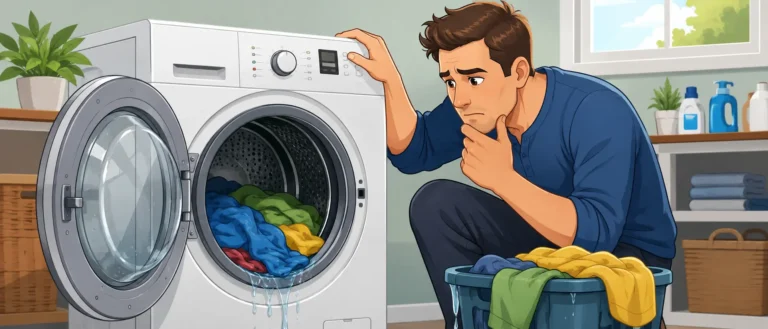
A washing machine full of water should be emptied before you inspect the filter or try to move the appliance.
Do not remove the filter completely while a full drum of water is sitting behind it.
Step 1: Try the Normal Drain Programme
If the controls still respond, choose:
Drain
or:
Drain & Spin
depending on your machine.
If the washer empties normally, the problem may have been temporary or related to the previous programme.
Step 2: Switch the Machine Off
If it still does not empty, switch the appliance off and unplug it.
If the water is hot, allow it to cool first.
Step 3: Look for an Emergency Drain Hose
Many front-loading machines have a small emergency drain hose behind the lower service flap.
Place towels around the machine.
Put the hose into a shallow container.
Remove its cap carefully and let the water flow out.
A full washer can contain a considerable amount of water, so you may need to empty the container several times.
Samsung’s emergency-drain instructions use this method on models equipped with an emergency drain tube. Samsung UK emergency washing-machine drain guide
Step 4: If There Is No Emergency Drain Hose
Check the instructions for your model.
Some machines allow water to be released gradually through the pump-filter opening.
Place a shallow tray underneath.
Loosen the filter slightly.
Allow a small amount of water to escape.
Close it again, empty the tray and repeat.
Do not pull the filter out completely until most of the trapped water has been removed.
Step 5: Inspect the Filter
Once the water level has dropped, remove and clean the filter.
Then refit it securely before testing the machine.
Washing Machine Not Draining or Spinning?
A washing machine not draining or spinning may have one underlying problem rather than two separate faults.
Most machines need to remove enough water before they can proceed to a high-speed final spin.
If water remains in the drum, the control system may delay or prevent normal spinning.
Samsung specifically notes that a machine that is not draining, or is draining too slowly, may also fail to spin correctly. Samsung UK drainage and spinning guidance
For other common faults, browse our Washing Machine Repair Guides
Water Is Still Visible in the Drum
Concentrate on:
filter → drain hose → waste connection → pump
The Drum Is Empty but the Clothes Are Soaking Wet
The problem may be more closely connected to:
- an unbalanced load;
- a low-spin programme;
- incorrect spin speed;
- a separate spinning fault.
This distinction prevents you from chasing a drainage problem when the washer has actually emptied normally.
What If the Washing Machine Is Draining Slowly?
A washing machine does not need to stop draining completely before there is a fault.
A washing machine draining slowly often points towards a partial restriction.
Start with the filter.
Then inspect the external drain hose.
After that, check the sink waste or standpipe.
Finally, confirm that the drain hose has been positioned correctly.
Listen to the Water Flow
A strong flow of discharged water is different from a weak trickle while the pump runs continuously.
If drainage has gradually become slower over several washes, accumulated debris is worth investigating before assuming an electronic fault.
Slow drainage is also worth addressing early.
A partial blockage can eventually become a complete blockage, leaving the machine full of water midway through a wash.
When Should You Call an Appliance Engineer?
Basic troubleshooting has a sensible stopping point.
Checking an accessible filter or external hose is very different from dismantling an appliance and electrically testing internal components.
Professional diagnosis becomes more appropriate when:
- the washing machine trips the electrical supply;
- you notice a burning smell;
- water has reached electrical areas;
- visible wiring appears damaged;
- the drain pump requires electrical testing;
- an error code repeatedly returns;
- internal components need substantial dismantling;
- the filter, hose and household drain are all clear but the machine still will not empty.
Before arranging a repair, note the:
- manufacturer;
- model number;
- error code;
- point in the programme where the washer stops;
- sound the drain pump makes.
That information can make the diagnosis considerably easier.
How to Prevent Washing Machine Drainage Problems
Small habits can reduce the chance of another blocked washer.
Check Pockets Before Every Wash
Coins, clips, tissues and other small objects can travel into the drainage system.
A few seconds checking pockets can prevent a much longer job later.
Clean the Drain Filter
If your washing-machine manufacturer recommends periodic filter cleaning, follow that guidance.
Do not wait until the drum is full of water before looking at the filter for the first time.
Check the Hose After Moving the Machine
Whenever the washer is moved, make sure the drain hose has not become trapped or sharply bent when the appliance is pushed back.
Use the Correct Amount of Detergent
More detergent does not necessarily mean cleaner laundry.
Use the quantity recommended for your load, detergent and machine.
Act When Drainage Starts Becoming Slower
A gradual change in drainage speed can be an early sign of a developing restriction.
Finding it while some water is still passing through is much easier than dealing with a completely blocked machine.
More Washing Machine Repair Help
GoodluckFix covers common appliance problems using step-by-step troubleshooting rather than jumping immediately to replacement parts.
Browse the Washing Machines repair guides for more washing-machine faults, or visit All Repair Guides to explore the full GoodluckFix troubleshooting library.
Frequently Asked Questions
Why Is My Washing Machine Full of Water After the Cycle?
Start with the drain filter and external drain hose. Then check the household waste connection.
A blockage anywhere along that route can prevent water from leaving the drum.
If those areas are clear, the drain pump or another internal drainage component may need further diagnosis.
Why Is My Washing Machine Draining Slowly?
Slow drainage commonly points towards a partial restriction.
Check the pump filter, drain hose and waste connection for debris, crushing, sharp bends or restricted flow.
A washer that gradually takes longer to empty should be checked before the restriction becomes complete.
Can a Blocked Filter Stop a Washing Machine From Spinning?
Yes.
If the washer cannot remove enough water, it may prevent or delay the normal high-speed spin.
That is why standing water should be investigated before treating the problem purely as a spinning fault.
How Do I Know if My Washing Machine Drain Pump Is Bad?
There is no single symptom that proves a pump has failed.
If the filter, drain hose and household waste are clear but the washer still will not empty, unusual pump noise, repeated drainage failure or no normal pumping sound can justify further pump diagnosis.
Why Are My Clothes Still Wet After the Spin Cycle?
Look inside the drum first.
If water remains, investigate drainage.
If the drum is empty, check the load balance, programme and selected spin speed instead.
Can a Kinked Drain Hose Stop a Washer From Emptying?
Yes.
A crushed, twisted or sharply bent drain hose can restrict the amount of water leaving the washing machine.
A partial restriction may cause slow drainage, while a severe restriction can stop drainage almost completely.
How Do I Drain a Washing Machine Manually?
Switch the washer off and unplug it.
If your model has an emergency drain hose, place it into a shallow container and release the water gradually.
If there is no emergency hose, follow the drainage procedure specified for your exact model rather than removing a full filter suddenly.
Should There Be Water Left in the Washing Machine Drum?
A visible pool of water remaining in the drum after a normal completed programme is not expected.
A small quantity of water may remain elsewhere inside the appliance’s internal hoses and pump system without being visible in the drum.
What Should I Check First if My Washer Will Not Drain?
Start with the drain filter.
Then inspect the external drain hose and household waste connection.
These are accessible areas that can cause drainage trouble without requiring the washing machine to be dismantled.
If all three are clear and the washer still holds water, investigate the pump or a model-specific internal fault.
Can a Washing Machine Drain Problem Fix Itself?
A temporary programme interruption may disappear after a reset or drain cycle, but a physical blockage usually does not fix itself permanently.
If the problem returns, check the drainage path rather than repeatedly restarting the machine.
Why Does My Washer Hum but Not Drain?
A humming sound may mean the drain pump is trying to operate but water cannot move freely.
A blocked filter, restricted hose or obstruction around the pump area are possible causes.
Check the accessible drainage points before assuming the pump itself has failed.
6 Comments
Comments are closed.